Skip to main content
Font Size




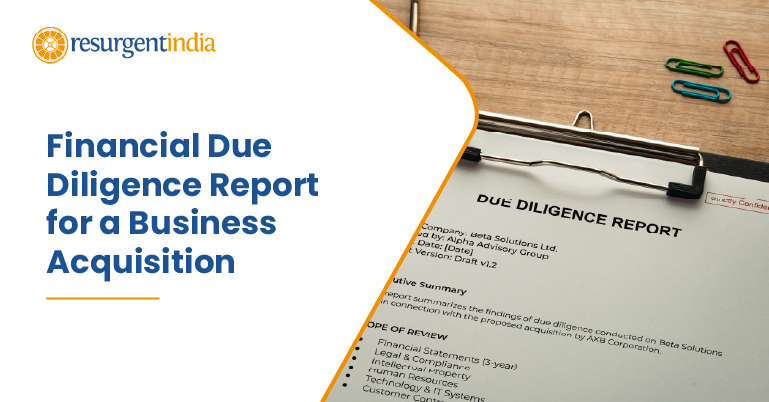
A financial due diligence report is a document that a potential buyer of a business uses to evaluate the financial health, liabilities, and funding needs of the business they are considering acquiring prior to entering into a transaction. In the case of an acquisition in India, the review must appropriately tie up the relevant evidence in the accounting records to the purchase price and the buyer’s intentions for control.
The findings are used to inform the business valuation by analyzing the earnings and cash flows supporting the deal. They also serve as inputs into the valuation report, negotiations and acquisition documentation. A useful review explains the financial effects of identified issues and records the information still further needed to arrive at an informed judicious decision.
Define what the financial due diligence report must cover
Consensualize the entities and the scope of review, financial information and transaction questions. Ask for audited statements, monthly management accounts, bank statements and schedules of the material information.
Compare these records and find out if there are any discrepancies. Schedule the financial review in conjunction with tax, legal and commercial specialists.
Schedule the review date in a timely fashion so that the results will be useful in discussing the issues. Provide for controlled access to sensitive records, designate the management team for responding, and agree on the level of escalation of significant issues during the review.
To value a business, it is essential to have a clear understanding of the business that is being acquired. Verify if there are any subsidiaries, shared assets or shared operations that need segregation. The same transaction perimeter should be used in the valuation report. This alignment enables the buyer to easily distinguish between the earnings, liabilities and operating costs that are part of the assessment for the acquisition.
Establish the earnings that can support the price
Discuss revenue recognition, unusual income, recurring expenses and changes in accounting treatment. Discuss proposed changes by management and evidence that any specific expense or benefit will be eliminated upon completion of the transaction. Review customer concentration and related party arrangements which may impact future profitability.
The financial due diligence report should harmonize the results with the earnings proposed in the transaction analysis. If in a business valuation, the ₹1 crore reduction in the maintained earnings is made, the calculated value is reduced by ₹6 crore in a business valuation based on six-times earnings multiple. The valuation report should clearly state the earnings measure and adjustments applied in calculating it.
Assess the working capital needed after completion
Analyse the quality of inventory, supplier payment terms and receivables ageing over a suitable historical period. Review seasonal variations and trends in the vicinity of the proposed completion date. The cash needed to run the business acquired may change due to slow collections, old stock or overdue suppliers.
Create a working capital benchmark based on the evidence in the financial due diligence report. Assumptions regarding collections, inventory, levels and payments should be consistent when valuing a business. These assumptions should be reflected in the valuation report. Identify the working capital accounts to be included in the acquisition and how any completion adjustment will be determined in the acquisition agreement.
Identify debt and other financial obligations
Review borrowing arrangements, repayment plan, guarantees and restrictions on cash.if any.Investigate about unpaid capital expenditure, employee obligations and other items that may require specific treatment in the transaction. Agree about the actual classification of debt, cash and debt-like items with the relevant advisers.
The financial due diligence should be able to support the reconciliation from enterprise value to the shareholder’s value. Definitions of business value and negotiated equity price must be similar. Ensure that the valuation report responds to the appropriate claims in a consistent manner. Assign each adjustment to one of the three categories (earnings, working capital and net debt) and explain the rationale for the assignment.
Test predictions and funding plan for acquisitions
Compare forecasts to historical revenue, orders, capacity and customer behaviour. Assess planned capital expenditure and the costs of integrating the business. Conduct scenarios with slower growth and later receipts and additional spending. Make a rough guess of the liquidity required after completion.
A financial due diligence report may reveal assumptions that need to be substantiated or the funding plan needs to be adjusted. Carry embraced changes in business valuation and examined how it affects expected returns. Update valuation report to incorporate the agreed forecast base. The proposal for acquisition funding should then present the cash amount required for the purchase, the cost of the transaction and the continuing cash needs.
Convert identified risks to transaction protection
Discuss balances, contingent liabilities, tax exposures and commitments with relevant experts, where there are any disputes. Estimate possible outcomes, if evidence allows, and document issues that are not resolved. Make a decision on what findings need to be further explored, the price needs to be adjusted, a condition for completion or a contractual protection.
The treatment of the different risks should be consistent with the business valuation. The assumptions and limitations should be disclosed in the valuation report.Transaction attorneys can evaluate appropriate representations, warranties, indemnities or retention agreements. Set tasks and deadlines for outstanding questions and ensure that task completion will be addressed as material developments are made from the review date to the completion date.
Apply the results to make an acquisition decision
Compile financial due diligence report, business valuation and proposed contract terms in an integrated format prior to final approval. Ensure that the decision makers at the end of the chain are fully aware of the relevant adjustments, any remaining evidence and the overall funding need. Confirm valuation report with final negotiated structure. Document rationale for doing and embed agreed monitoring actions into the ownership transition.